

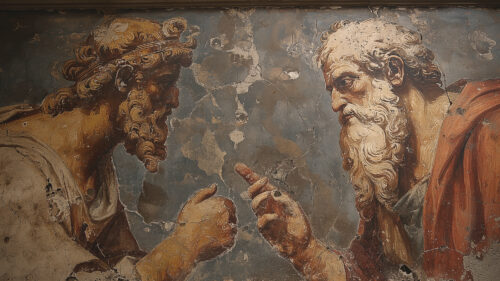
Sons of Zion vs. Sons of Greece
The Ongoing Conflict Between Truth and Error
When Zechariah was moved of God to predict a coming conflict that would impact the nation of Israel, he succinctly encapsulated the ongoing battle between truth and error that rages to this day. In Zechariah 9:13-14, 16, the prophet quoted God as saying, “I will stir up your sons, O Zion, against your sons, O Greece, and make you like a warrior’s sword. . . . and the Lord God will blow the shofar . . . and the Lord their God shall save them in that day as the flock of his people. They will sparkle in his land like jewels in a crown.”
What the prophet predicted was the rise of the children of Yavan, Ionia or Greece, personified in Alexander the Great, who conquered the entire Middle East around 334 BC, and even more particularly in Antiochus IV, who assumed to himself the title of Epiphanes (God manifest) and initiated a reign of terror upon the inhabitants of Judah in 167 BC, forbidding the practice of Jewish faith and tormenting and murdering the Jewish people.
While the Israelites and their linear descendants have been subjected to relentless and systematic attacks throughout their history even to the present day, the invasion of the Greeks and the despotic domination of Antiochus represented the most insidious attack ever launched against the God of Israel and his chosen people. This conflict was not just another military venture initiated in an attempt to control Israel because this nation is situated on the land bridge at the confluence of three continents.
Israel had suffered many times at the hands of foreign invaders. This time, however, the conquerors brought with them their ideas of religion, politics, philosophy, and sociology. In their military and political train, the Greeks also carried Hellenism, a worldview and mindset that is entirely inimical to the worldview and mindset of the Hebrew Scriptures and, therefore, of God himself.
The reason that Hellenism was so insidious to the Israelites was that it was initially introduced as a great economic boon to the people and a dramatic step forward in humanism and the exaltation of rationalism. Alexander was subtle in that he did not force the Greek religion on his subjects but allowed them to continue to worship their own gods and to maintain their own cultures. This made Hellenism much more attractive, especially to the aristocrats and the intelligentsia of the conquered lands. Significant profits were to be made by accommodation with the Greeks and their Hellenism (so termed by the name that the Greeks used for themselves, Hllhn—Hellen).
The grave danger of the Greek invasion of Israel, then, was not so much in the physical destruction (like that of the Babylonian conquest). It was the extreme danger to the Jews and to Judaism that was posed by the religion and philosophy of the Greek realm. Hellenism is entrenched in rationalism, humanism, and polytheism (though Greek rationalism does posit a “God” as the “First Cause” or the “Unmoved Mover” who created the universe and then absented himself from it).
Insidious Hellenism
Hellenism encapsulated everything that is in direct opposition to the God and the religion of Scripture. It elevated man and rationalism to the pinnacle of worship while carrying along with it superstition about gods and goddesses and a hyperreligiosity that even created shrines to the “unknown god” (Acts 17:23). This was the worldview and religion that Paul excoriated in Romans 1:22-28: “Professing to be wise, they became fools, and exchanged the glory of the incorruptible God for an image in the form of corruptible man . . . They exchanged the truth of God for a lie, and worshipped and served the creature rather than the Creator. . . . For this reason God gave them over to shameful lusts. Even their women exchanged natural intercourse for unnatural. In the same way also the men abandoned natural intercourse with women, and were inflamed with lust for one another. Men committed indecent acts with other men . . . And since they did not see fit to acknowledge God, he gave them up to a depraved mind and to things that should not be done.”
The apostle’s description of Hellenism and its impact upon human beings was graphic, uncompromising, and entirely correct. Long before Antiochus, philosophers like Socrates, Plato, and Aristotle had conceived a god entirely different from the God of Scripture, and they had worked out their ideas of truth and how they should be applied to society. Today, Plato, one of the high priests of Greek rationalism, would be considered a pervert in today’s society and would be imprisoned for pederasty, for his idea of truth was to gaze upon the nude body of a prepubescent boy and then to engage in anal intercourse with the child.
The conflict between the sons of Zion and the sons of Greece is the timeless battle between the truth of Scripture and the philosophies of man.
Humanism and the worship of the rational mind lead to a debased view of humanity in general that descends in a downward spiral of debauchery and unnatural lust. It fosters unbridled narcissism—the worship of self, particularly of the human male. It also leads to deprecation and abuse of women—an endemic characteristic of ancient Greek culture—and of other human beings whom the all-wise philosophers consider to be essentially less than human. Ultimately, it leads to state-enforced abortions, infanticide, and euthanasia as the unending quest for what is best for society ends in eugenics, the determination to breed out of society whatever offends the ruling class.
Sounding the Alarm in Ancient Judea
When Hellenism was poised to make a perfidious and subtle attack upon Israel, the prophets sounded the warning shofar with loud blasts against this syncretism: “I will raise up your sons, O Zion, against your sons, O Greece” (Zechariah (9:13); “A little horn . . . cast the truth to the ground . . . by him the daily sacrifice was removed, and the place of the sanctuary was brought low” (Daniel 8:9, 11-12). The ominous prophecies of Daniel were literally fulfilled when Antiochus changed his policy of peaceful syncretism to force Hellenism upon the Jewish people with the edge of the sword. He polluted the Jerusalem temple by establishing a shrine to Zeus and offering swine on God’s altar. He established a house of prostitution in the very temple complex, and he murdered large numbers of the Jewish people who dared to resist his efforts. In effect, he forced the violation of the three commandments of the Torah for which the sages agreed must never be violated by the Jews, even upon the penalty of death: idolatry, murder, and adultery In spite of the fact that the aristocracy, led by the Tobiad family, and much of the temple priesthood bureaucracy had embraced Hellenism as an economic and political boon to Judea, people of conscience and faithfulness to the Torah, led by Mattathias the Hasmonean, rose up in rebellion against the imposition of such perverse ideas and vile practices on the Jewish people. Subsequently the sons of Mattathias, Jochanan, Simeon, Eleazar, Jonathan, and Judah, led a guerilla warfare action against Antiochus. Judah assumed leadership and became known as Yehuda HaMakabi (“Judah the Hammer”).
Finally, Antiochus and his forces were driven from Judea. Subsequently, the faithful began the task of cleaning up the temple and renewing the worship of Yahweh. When the cleansing had been completed, the sanctuary was rededicated in an act of solemn service. In the process, when it came time to light the temple menorah, the priests discovered that all but one flask of the consecrated oil had been destroyed. Additional oil required eight days of preparation, so they were faced with deciding whether to wait until they had an adequate supply. In an act of faith, they determined that they should immediately light the lamps of the menorah, whereupon they witnessed a miracle when the flames burned for eight days on the one-day supply of oil. This was God’s seal of approval upon the rededication, and it was confirmation that dedication always produces light!
The Lingering Effect of Hellenism
Unfortunately, even though Hellenic influences were eradicated from the temple compound and the prescribed worship of God was restored, Hellenism continued to impact the nation of Israel. Even the sages and rabbis were significantly affected by Greek thought, especially by rationalism but also in many other areas as well. It was this influence that Jesus sought to correct when he introduced his reformation of Jewish faith. “You nullify the Word of God by your tradition that you have handed down,” Jesus charged (Mark 7:13). Increasingly, rationalism led religious leaders in Israel to circumvent the Scriptures themselves and to elevate their own ideas as a tradition that was, in effect, superior to God’s written Word.
Jesus urged a return to the Scriptures alone as the rule of faith, practice, government, and discipline for the Jewish people. He enjoined this principle upon his disciples, who initially were careful to maintain his distinction, as can be seen in Paul’s confession: “As a follower of the Way, which they call a sect, I believe everything that agrees with the Law and that is written in the Prophets” (Acts 24:14). He also boldly instructed the believers in the Messiah: “Do not go beyond what is written” (1 Corinthians 4:6).
There can be no mistake as to the diligence of the first-century believers to maintain careful dedication to the Hebrew Scriptures alone and to distance themselves from the influence of Hellenism, paganism, and mystery religions. The apostles and elders even commanded the Gentiles who had come to faith in Jesus as Messiah to abstain completely from every form of idolatrous practices that were associated with the traditions of non-Jewish religious and philosophical traditions (Acts 15:29).
Never Say Die
Eventually, Hellenism had its way in the Christian church—and to a much greater degree than it had had in Judaism. As the church became increasingly Gentile both in demographics and in leadership, the trend toward transforming the faith of the Hebrew Scriptures into a religion syncretized with Hellenism rapidly accelerated. The Jewish roots of the Christian faith were eventually severed so that even the Christian understanding of God was significantly altered from the Jewish understanding of the God of Scripture.
Compromise led to accommodation and subsequently to outright appropriation of much of the philosophy and tradition of the Greco-Roman world. The church was ripped from its safe moorings in the harbor of biblical truth and set adrift in the maelstrom of human tradition. Despite repeated efforts at reformation, restoration, and renewal, the Christian church has continued to be influenced more by Greek philosophers than by Jewish prophets for some nineteen centuries.
Upping the Ante
As time has marched on and the coming of the Messiah has drawn closer, the spiritual powers that stand in opposition to the Lord and his Messiah have increased their attacks upon the simple faith of Jesus and the apostles. The rationalism of the Age of Reason and the Enlightenment re-entrenched Hellenism in Western culture and in the church.
Even in the greatest outpouring of revival and renewal in the history of humanity that unfolded around the world during the twentieth century, Christianity became more and more influenced first by modernity and then by postmodernity. Modernity posited the idea that humans were evolving and would continue to evolve into a utopian society where all will be perfect and without God. When that vision was shattered by the bloody world wars and by the Holocaust of unimaginable proportions, modernity lost its luster, and postmodernity ensued.
It is time to sound the shofar and summon the sons of Zion to stand for truth against the rising tide of humanism and neo-paganism.
In this system, New Age philosophy and Neo-Paganism have flourished in most Western societies, introducing a syncretism between monism and Hellenism to produce a monster of political correctness gone mad. Abortion on demand and even infanticide are regularly practiced with little public outcry, and euthanasia is peeping its ugly head over the horizon. Respect of the fundamental value of human life is diminishing even in formerly solid Christian nations.
Hedonism has again become the order of the day to a degree that would make the ancient Epicureans proud. Immorality and its consequences are glamorized throughout the entertainment industry, including in music, radio, television, and motion pictures. Everything is filled with sex and violence, and the participants become younger and younger, fueled by industries that are filled with greed and are led by openly immoral and debauched people who are glamorized for the depravity that has reaped them wealth and notoriety.
Where Are the Sons of Zion?
It is time for a clarion call to go forth to summon the sons of Zion to stand against the rising tide of neo-Paganism and neo-Gnosticism, as well as the narcissism and materialism that has infested the church. In a world that champions tolerance for anything but the God of the Jews, it is time to sound the shofar and assemble the forces of righteousness—the sons of Zion—to stand against the abominations that bring desolation to humanity and thrust millions of people into open defiance of the God of Israel.
Like the unending battle between the Israelites and the Amalekites that, as God predicted, has raged for more than three millennia, the battle between the sons of Greece and the sons of Zion featuring warfare by the forces of humanism against the God of Scripture has raged unabated for more than two thousand years. The intensity of this battle will increase as the time of the Messiah draws near. Evil personified will exalt itself and seek to supplant the God of the Bible.
Who will stand for truth? Who among the Jews and the Christians will make up the new spiritual Israelite army that will light the torches of truth and dispel the darkness of a world hell-bent on destruction? Where are the sons of Zion who will battle for truth against the human philosophies and pagan religions and philosophies that threaten the existence of civilization itself? It’s time to stand up and be counted!
