Lech L’Chah
The Universal Implications of God’s Imperative to Abraham
Beit Midrash on Torah & Biblical Studies
Lech l’chah is the Hebrew imperative that launched a new day in human history which has endured with phenomenal consistency for four thousand years. God chose one man and commanded him, “Go!” The man was Abram, whom God later surnamed Abraham, and the command was the foundation of enduring instruction from a living and active God to a people whose commitment to the revelation of his Word would make them uniquely his “Chosen People.” In this one intersection of divine imperative and human faith, the universality of God took on particularity. Through divine election, God would forever after have a family and eventually a nation that would be the agent he would use to advance his kingdom to the ends of the earth, a people through whom he could—and would—bless “all the families of the earth” (Genesis 12:3).
Go for Yourself!
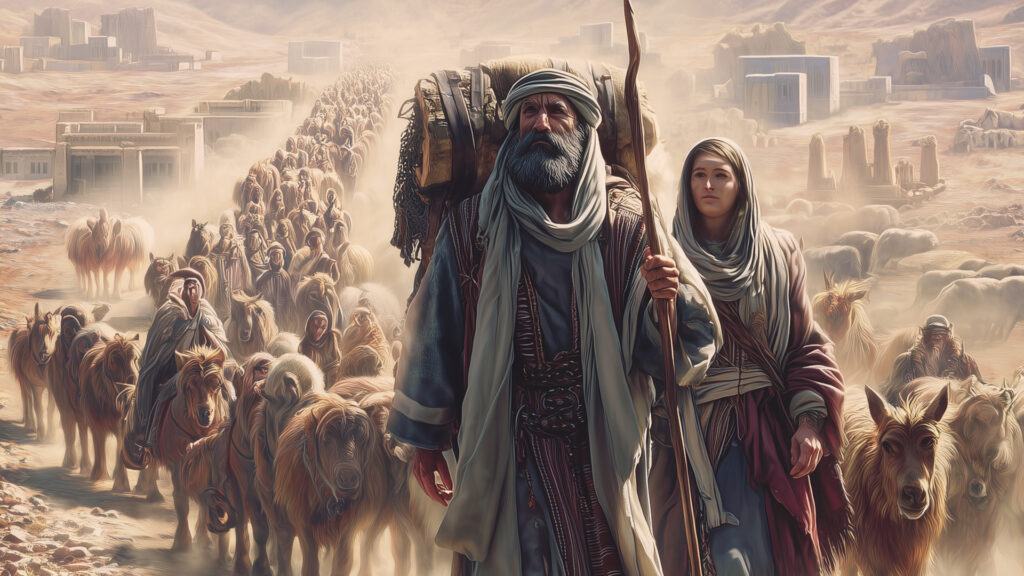
Lech l’chah is an idiomatic alliteration and an emphatic command: “Go!” Translated literally, however, it can mean “Go for yourself,” meaning that you “summon from within yourself all of your inner resources and go,” or it can mean “Go to yourself,” suggesting that you “discover your most authentic self and align with your higher purpose.” The further details that God gave in this command were summed up in the sacred text in this manner: “Go forth from your country and from your relatives and from your father’s house to the land which I will show you” (Genesis 12:1). In this sense, lech l’chah means (or implies), “Get out!” This was the divine summons that moved Abraham and his wife Sarah from the comfort zone of family and citizenship in Haran of Assyria to the status of nomads, transient aliens, or strangers (gerim) in a land that was foreign to them. Throughout Abraham’s lifetime thereafter, the patriarch was never again to be a settled, landed citizen. Even though God promised him all of the land of Canaan, he found it necessary to purchase the Cave of Machpelah in Hebron in order to own a burial site for himself and his family (Genesis 23:8). Abraham and Sarah simply moved at God’s command. They were, quite literally, nomads of faith, prisoners of hope (Zechariah 9:12), moving toward an uncertain—yet absolutely secure—future!
As is so often the case, God immediately followed his challenging and abrupt lech-l’chah command to Abraham with this promise: “I will make you a great nation, and I will bless you, and make your name great; and so you shall be a blessing; and I will bless those who bless you, and the one who curses you I will curse. And in you all the families of the earth will be blessed” (Genesis 12:2–3). God revealed from the very inception of his action in Abraham’s life that the ultimate intention in his divine calling was beyond the scope of the patriarch’s own life and that of his immediate, lineal descendants. It was a plan to employ him and his progeny as agents for advancing divine dominion until “the knowledge of the glory of the Lord [would] cover the earth as the waters cover the sea” (Habakkuk 2:14).
From Babylon to Canaan
Abraham received his lech l’chah command in Haran of Assyria (modern-day Turkey), which was a significant place strategically positioned at the intersection of two important trade routes, one between the Mediterranean and the Tigris River and the other between Antioch and Nineveh. Haran (“Crossroads”) was an apropos name for this Mesopotamian city.
So, why was Abraham, the Sumero-Babylonian even in Haran to begin with? His father Terah had departed from Ur of the Chaldees some 60 years before that time, taking with him his son Abraham, his daughter-in-law Sarah, and his grandson Lot. Scripture says that they “went out together from Ur of the Chaldeans in order to enter the land of Canaan; and they went as far as Haran and settled there” (Genesis 11:31).
Terah was an idol worshiper (Joshua 24:2) and, according to midrashic tradition, a craftsman and merchant of stone idols (Genesis Rabbah 38:13). He may well have been a “wicked” (Numbers Rabbah 19:1; 19:33) and “idolatrous priest” (Midrash haGadol on Genesis 11:28). It is doubtful, therefore, that he had received any divine instructions regarding his travel plans as Abraham had done, but he did set out with the goal of leaving Ur and settling in Canaan.
Instead of continuing his planned itinerary, however, he was easily distracted and settled his family in Haran. In effect, the transitioning of vision became “hung up in Haran” and, therefore, failed to reach Canaan. The Terah family remained in Haran for a great length of time, allowing them to be citizens of that city with the rights and privileges thereof. It was 57 years after the departure from Ur when Abraham left Haran in obedience to God’s specific command at that in time and in that place.
The lifestyle that had driven so many of Abraham’s ancestors was clearly reflected in Abram. In fact, God even commanded him directly to “walk before me and be perfect” (Genesis 17:1) like his progenitor Enoch had done (Genesis 5:24; Hebrews 11:5). His perfection was simply a reiteration of the description of Noah, his more recent ancestor, who “walked with God” and was “perfect” (“blameless” and “upright”) in his genealogy (Genesis 6:9). Even though he was a Babylonian by birth and an Assyrian by nationality, he knew where his loyalties lay. He was a descendant of Shem, a member of the Semitic peoples, the ones who served the one and only God, the God of Noah.
Along the way of transition from Babylon to Syria, Abraham began a walk of faith. He “believed God.” He was not a procrastinator. When God said something, he reacted immediately by doing what God instructed (Genesis 22:3). He was not starry eyed, impulsive, or irrational. He simply moved systematically in the direction of divine instruction, never hesitating in doubt as to what God had said or what he had meant. Even though he did not know the daily details or even the precise ultimate objective of his walk, Abraham moved on with God. He would be satisfied with whatever God gave him; however, his expectation was that he would discover that pristine city “whose architect and builder is God” (Hebrews 11:10).
Walking by Faith
Because of his immediate obedience to divine imperatives, Abraham has been viewed in both Jewish and Christian tradition “as a man of faith: a faith so profound, so firm, so unclouded, that he can converse with the Creator of the universe as naturally as ordinary human beings talk to one another.”1 Because of his faith and faithfulness, “Abraham is the first Hebrew, the founder of the Hebrew nation and the path-breaker who created the Hebrew religion.”2
Here is how the apostle Paul summarized the patriarch’s chosen relationship with God: “Abraham believed God, and it was credited to him as righteousness” (Romans 4:3). The apostle James agreed with Paul: “Abraham believed God, and it was credited to him as righteousness, and he was called the friend of God” (James 2:23). The incident that prompted the biblical declaration on which these words are based took place when Abraham sought divine confirmation of the terms of the covenant. Then, in response to God’s promises, “[Abraham] believed in the Lord, and [God] reckoned it to him as righteousness” (Genesis 15:6). Because of the profound degree of his faith and faithfulness, Abraham has been called the “Father of Faith” (Galatians 3:6–9). In fact, Paul calls him “the father of us all” (Romans 4:16)—that is, the father of all those—whether Jew or Gentile—to whom the righteousness of God has been imputed because of their faith in God. His standing resolutely on God’s promise without wavering in doubt or confusion made Abraham the epitome of the Hebrew word for faith: emunah which means “steadfastness,” “constancy,” “reliability,” and “faithfulness.”
The Land Contract
When Abraham received the divine commission to “Go!” he was immediately given this assurance by the Almighty: “I will make you into a great nation, and I will bless you; I will make your name great, and you will be a blessing. I will bless those who bless you, and whoever curses you I will curse; and all the families on earth will be blessed through you” (Genesis 12:3). Abraham had gone forth from Haran with that benediction, knowing that he would be blessed and that he would also be a blessing to all the families of the earth.
Then, shortly after Abraham entered the Promised Land, God appeared to him again and added a new dimension to his promise by saying, “To your offspring, I will give this land” (Genesis 12:7). Subsequently, after Abraham had ceded the finest land in Canaan to Lot in order to have peace, God said to him, “Lift up your eyes and look northward, southward, eastward, and westward, for all the land that you see I will give to you and your offspring forever” (Genesis 13:14–15). Later, when Abraham inquired of God, “How shall I know that I will inherit [this land]?” the Lord further expanded the land promise in this manner: “To your descendants have I given this land, from the Wadi of Egypt to the great river, the River Euphrates . . .” And the narrative continued, saying, “On the same day the Lord made a covenant with Abram” Genesis 15:8, 28).
God did not call Abraham merely to be blessed. He commanded him, ‘Be a blessing’ to all the families of the earth.
The apostle Paul even took the expansion of the land contract much further when he said, “For the promise to Abraham or to his descendants that he would be heir of the world (kosmos) was . . . through the righteousness of faith” (Romans 4:23). This description of God’s land promise to Abraham was that not only Canaan but also the kosmos would be given to him and to his descendants—in this case, through the Messiah in the Olam haBa (“age to come”). This belief “that Abraham and his seed were to inherit the kosmos . . . fits with broader trends in early Judaism,” says Matthew Thiessen.3 The connection with the Promised Land—and much, much more—was an integral part of the Abrahamic covenant; however, God himself conveyed spiritual title to the entire world to Abraham and to his linear and spiritual descendants forever, even when he will create “new heavens and a new earth, wherein righteousness dwells” (Isaiah 65:17; 66:22; 2 Peter 3:13).
Abraham, therefore, was the first man with whom God entered into a covenant in which he promised that he would forever maintain a special relationship with him and his descendants. “The Lord appeared to Abram and said to him . . . ‘I will establish my covenant between me and you and your descendants after you in their generations, for an everlasting covenant, to be God to you and your descendants after you. Also, I give to you and your descendants after you the land in which you are a stranger, all the land of Canaan, as an everlasting possession; and I will be their God’” (Genesis 17:1, 7–8).
The land contract that was an intrinsic part of the Abrahamic covenant focused God’s particular attention and focus upon one geographical space. The land from the Wadi of Egypt to the River Euphrates was singled out specifically as the physical place that God would assign to Abraham and his descendants—again, “forever.” It was as though God were choosing a set-apart land mass in which to establish his capital city, the place where he would place his name (1 Kings 11:36; Ezra 6:12). This real estate would be the canvas on which he would paint the mural of his dealings with humanity from Abraham’s day until the day of the Messiah. According to the land unilateral and irrevocable conveyance in the Abrahamic covenant, God is also as much a particularist when it comes to geography as he is when it comes to people. Just as he uses one people to bless all people, so he uses one land to demonstrate his plans for the entire earth, even when “the meek inherit the earth forever” (Psalm 37:12; Matthew 5:5).
Abraham and his descendants would be blessed, and he and they would be a blessing to all the families of the earth, thereby inheriting the kosmos in the process of the universal blessing. As David Dilling observes, it is reasonable “to believe that Abraham understood the promise of his heir to be a universal blessing included his understanding that his heirs will inherit the whole world.”4 This inheritance is possible because of God’s “promise that through Abraham’s innumerable posterity ‘all nations of the earth’ would be blessed.” In his wildest dreams, Abraham could never have communicated by himself his good news of monotheism and divine justice and mercy to all the nations of the earth; however, through his descendants—both linear and spiritual—he has done so and will continue to do so until the advent of the messianic kingdom.
Be a Blessing!
When God told Abraham, “You shall be a blessing” (Genesis 12:2), he was doing far more than simply announcing that in the future Abraham would bless others, thereby extending his election beyond the covenant community that would be established though his progeny. The Hebrew verb translated universally as “You will be [a blessing]” is not in the future tense at all. In fact, it is not even in the indicative mood. The verb heyeh is a Qal imperative form of the verb hayah (‘to be”). In contrast, the simple masculine second-person singular future tense of the verb hayah is tihye. The Hebrew text is clear then: God’s statement was an imperative, not an indicative, and, consequently, it was prescriptive and not merely predictive. God was not merely predicting that Abraham would be a blessing in the future: he was commanding Abraham to “be a blessing” at all times. Christopher J. H. Wright even terms heyeh as an “imperative of intention,” therefore, says he, the Abrahamic covenant “is a self-replicating gene. . . . Those who receive it are immediately transformed into those whose privilege and mission it is to pass it on to others.”5 And the command “Be a blessing!” is transmitted with the blessing for those who receive it through faith. This is why Martin Buber says that this “unprecedented imperative” is essential to the understanding of God’s commission to Abraham.6
An Apostolate to the Nations
Abraham was an envoy, an ambassador of God’s kingdom. He represented “the everlasting good news” of that kingdom, which is encapsulated in the message: “Fear God and give glory to him [alone]” (Revelation 14:7). He was commissioned to be God’s shaliach or apostolos (“one sent”) when the Almighty commanded him, “Lech l’chah!” And he proclaimed a profound message of theretofore unknown truth: “Yhwh alone is God.” As such, Abraham had an apostolate both to his own people and to the nations that was similar in nature to Paul’s apostolate that was confirmed to him when “. . . by revelation [God] made known unto me the mystery . . . which in other ages was not made known unto the sons of men, as it is now revealed unto his holy apostles and prophets by the Spirit” (Ephesians 3:5).
From the time that Abraham came to understand the mystery of monotheism—not through his own investigation but by means of divine self-disclosure (revelation)—he was commissioned to be the channel through whom God would make this truth known universally, and he was “sent” by God to share his insight into that mystery with all people. Abraham surely had an apostolate to be an ambassador of God’s kingdom with a message of the mysteries of monotheism: faith, justice, mercy, and salvation.
The Abrahamic covenant reveals God’s pattern: one people, one land, and one mission to bless the whole world.
Abraham was not only an apostle but also an evangelist/missionary who declared the good news of the kingdom of God, the truth about the One God. “The implications of this image of Abraham and Sarah as missionaries reverberate throughout history,” says Jon Levenson.7 The image of Abraham’s mission to the nations is preserved in classical rabbinic literature, where “Abraham is portrayed as proclaiming the name of God in public; leading people to recognize the monotheistic belief; practising common missionary acts; serving food and taking care of people’s needs in order to, or in a manner that, brought them either to the faith, to God, or to the Jewish people,” says George van Kooten.8
Shlomo Riskin cites Maimonides to explain this truth: “Once Abraham recognized and understood the ethical God, he began to tell the idolaters that they were not pursuing the true path; he broke their idols and informed the people that it is only proper to serve the God of the world.” In this context, Abraham “stood up and called out in a great voice to the entire world that there is only one God in the entire universe and it is only him that they must serve.” In a very evangelistic and peripatetic manner, Abraham “would walk about, call out and gather people from city to city and from kingdom to kingdom until he reached the land of Canaan” where “the people would gather around him and ask him questions, and he would teach each of them according to their respective knowledge, until he would bring them to the path of truth. . . .”9
Preaching from Babylon to Canaan
From Scripture and history, it is clear that Abraham, like Noah before him, was a “preacher of righteousness” (2 Peter 2:5). In fact, it appears that while he lived in Haran and before his lech l’chah summons, Abraham had been busy sharing the everlasting Gospel of God (monotheism) and evangelizing and converting the pagans around him. Scripture says that when he prepared to go to the Promised Land, “Abram took Sarai his wife, and Lot his brother’s son, and all their possessions that they had gathered, and the persons whom they had acquired in Haran, and they set out for the land of Canaan” (Genesis 12:5). In this text, the Hebrew word that is translated “persons” is nephesh, which literally means “souls” or “lives” (Genesis 2:7) and hence “persons.” Allen Ross maintains that the word nephesh would not have been used in this instance to designate servants or slaves.10 If, as Umberto Cassuto argues, “in this context nephesh probably referred to proselytes,”11 it is virtually certain that Abraham was evangelizing and sharing his faith in the one true God in Haran.
As he waited at the crossroads of Haran during his time of transition from Babylon to Bethel, therefore, Abraham had been evangelizing those whom he met, sharing with them the gospel of the one God whose unity and singularity he had come to understand, and a number of those whom he had urged to convert from idolatry to monotheism accompanied him and Sarah to the Promised Land. This was but a demonstration of the power of the good news and a confirmation of Paul’s contention that “the gospel was announced in advance to Abraham: ‘All nations will be blessed through you’” (Galatians 3:8). Abraham received the Gospel of God, and he could not help but share it with everyone with whom he came in contact.
Being a Blessing in the Promised Land
Then, after Abraham entered the land, he built altars, which were an acts of publicly introducing his God to pagan lands and peoples. Finally, after noting that Abraham “built an altar,” Scripture says, “[he] called upon the name of the Lord” (Genesis 13:4). While the Hebrew word קָרָא–kara in this text can mean “called upon,” it can also mean “cried out” or “proclaimed.” Ross maintains that the proper rendering of the passage is “[he] made proclamation of the Lord by name” by noting that “in Mosaic material [kara] seems to be broader” than mere prayer or praise.12 James Aitken notes that “all the Palestinian targumic translations of the Pentateuch on Genesis 21:33 present Abraham informing strangers about the God of Israel,”13 while Hayward says that Pseudo-Jonathan “is more educative than missionary in intent, presenting [Abraham] as a preacher.”14 This text, therefore, is better translated as in the Tanakh Version: “[He] invoked the Lord by name” or as in Young’s Literal Translation: “[He] preached in the name of Jehovah.”
Martin Luther shared the same idea when he translated the passage, “[Ábrám] predigte von dem Namen des HERRN (“[Abram] preached in the name of the Lord.”).” David Klinghoffer says that “on the mountain between Beth-el and Ai,” Abraham had been “preaching and evangelizing . . . living with and instructing his followers and slowly rebuilding the fellowship of disciples he’d had at Haran, whose total number of 72 when he left Mesopotamia climbed before long to 318.”15 Indeed, Abraham had wisely positioned himself adjacent to the public square and the city gates (Proverbs 1:20–21), and he had built altars where he publicly worshiped God and proclaimed the good news. Abraham, therefore, was both a recipient of the gospel of God and a preacher of it.
For many years after this time, Abraham was found sharing the truth of monotheism near Hebron. It is said that when Abraham established his tent complex there under the terebinth trees of Mamre (Genesis 18:1), he did so in order to be strategically positioned at a center of travel and commerce and in an area where polytheists often engaged in pagan rites so that he could be a clear and obvious witness to the one God who had revealed himself to him. There, he built a sanctuary with an altar and continued his work of evangelizing and converting the Gentile pagans to the faith of the Almighty.
Abraham shared the insight that he had received as a child by divine revelation assuring him that the Lord, the God of the universe, is one, and he taught the lessons of divine justice to all. The patriarch of covenant and blessing heralded the euangelion, the good news of God’s salvation and blessing for the nations, the same message that still echoed a millennium thereafter when the prophet Isaiah exclaimed: “How beautiful upon the mountains are the feet of the messenger who announces peace, who brings good news, who announces salvation, who says to Zion, ‘Your God reigns!’”(Isaiah 52:7). This is the good news that “translates” those who receive it from the dominion of darkness into the kingdom of God” (Colossians 1:13).
Walter Kaiser Jr. concludes that “the extent of that kingdom had already in its earliest design embraced the steady absorption of Gentiles as well as Jews. Furthermore, there were numerous illustrations of this historical inclusion of the Gentiles.” It is clear, therefore, that, as Jewish tradition teaches, Abraham was “not only the first Jew but also the first missionary” in that “he proclaimed the one God” and “brought in converts.”16
Leaving, Going, Blessing
Lech l’chah, still remains as God’s foundational declaration to all the Family of Faith and Faithfulness. All other summons from the Eternal are similar and derivative from the original call, Lech l’chah. God still says to everyone on Planet Earth: “Leave Babylon! Go to the Promised Land! Repent and be baptized! Cross over into the Kingdom of God! Walk with God! Proclaim the good news of the Messiah! Make disciples! Be a blessing!”
1 John D. Rayner, An Understanding of Judaism (Oxford, UK: Berghahn Books, 1997), p. 17.
2 Shlomo Riskin, “Parashat Lech Lecha: Why God Chose Abraham,” The Jerusalem Post, Oct. 25, 2012.
3 Matthew Thiessen, Paul and the Gentile Problem (Oxford, UK: Oxford University Press, 2016), p. 158.
4 David R. Dilling, The Epistle to the Romans (Lafayette, IN: Kensington Theological Academy, 2001), vol. 1, p. 182.
5 Christopher J. H. Wright, The Mission of God: Unlocking the Bible’s Grand Narrative (Downers Grove, IL: InterVarsity Press, 2006), p. 236.
6 Martin Buber, “The Election of Israel: A Biblical Inquiry (Exodus 3 and 19; Deuteronomy),” in On the Bible: Eighteen Studies, ed. Nahum N. Glatzer (New York: Schocken Books, 1968), p. 87.
7 John D. Levenson, Inheriting Abraham: The Legacy of the Patriarch in Judaism, Christianity and Islam (Princeton, NJ: Princeton University Press, 2012), p. 136.
8 George van Kooten and Jacques van Ruiten, “Abraham’s Children in the ‘Genome’ and the ‘Pre-Genome’ Era,” in Abraham, the Nations, and the Hagarites: Jewish, Christian, and Islamic Perspectives on Kinship with Abraham, ed. Martin Goodman, George H. van Kooten, and Jacques T. A. G. M. van Ruiten (Leiden, The Netherlands: Koninklijke Brill nv, 2010), p. xxv.
9 Maimonides, quoted in Riskin, “Parashat.”
10 Allen P. Ross, Creation and Blessing: A Guide to the Study and Exposition of Genesis (Grand Rapids, MI: Baker Book House, 1996), p. 265
11 Umberto Cassuto, From Noah to Abraham, Genesis 6:9–11:32, trans. Israel Abrahams (Jerusalem, Israel: Magnes Press, 1964), pp. 320–321
12 Ross, p. 265.
13 James K. Aitken, “Jewish Tradition and Culture,” in The Early Christian World, ed. Philip E. Esler (New York: Routledge, 2000), p. 93.
14 C. T. Robert Hayward, “Abraham as Proselytizer at Beer-Sheba in the Targums of ht e Pentateuch,” Journal of Jewish Studies 49, pp. 31–36.
15 David Klinghoffer, Abraham and the Birth of Monotheism (New York: Doubleday, 2003), p. 82.
16 Walter C. Kaiser Jr., “The Davidic Promise and the Inclusion of the Gentiles (Amos 9:9–15 and Acts 15:13–18): A Test Passage for Theological Systems,” Journal of the Evangelical Theological Society, vol 20, no. 2, June, 1977, p. 99.
About the Author

John D. Garr, Ph.D.
President & CEO